When Fiction Meets Reality: A Unique Approach to Language Learning
Blended learning has become an increasingly prominent model in contemporary language education. By combining classroom instruction with digital self-study materials, blended learning allows learners to reinforce linguistic input through multiple modalities and at different moments in time. Numerous studies have shown that blended learning environments can improve language acquisition outcomes, particularly in speaking proficiency and vocabulary development, compared with traditional classroom-only instruction (Zhou & Zhang, 2022; Springer Nature, 2026).
At Bart de Pau Language Courses, we try to expand this blended learning model into a more comprehensive learning ecosystem. Participants in the intensive Dutch courses not only attend lessons but also stay on campus for ten days. The Language Campus is located at Vakantiepark Het Timmerholt in the province of Drenthe, where learners live, study, and interact in Dutch throughout the duration of the program.
This residential component transforms the learning experience into a form of linguistic immersion. Unlike traditional language courses where students attend a few hours of lessons and then return to their normal daily environment, the campus model creates a setting in which exposure to the target language continues beyond the classroom. Language learning therefore becomes a continuous process that extends throughout the day. Informal interactions and social activities create additional opportunities for authentic communication.
Research in second-language acquisition consistently demonstrates that immersive environments increase both the quantity and quality of language input and output. Immersion not only exposes learners to real-life communicative situations but also encourages them to actively use the language in meaningful contexts. Such environments support the development of communicative competence and reduce anxiety associated with speaking in a second language (Chen & Hwang, 2020).
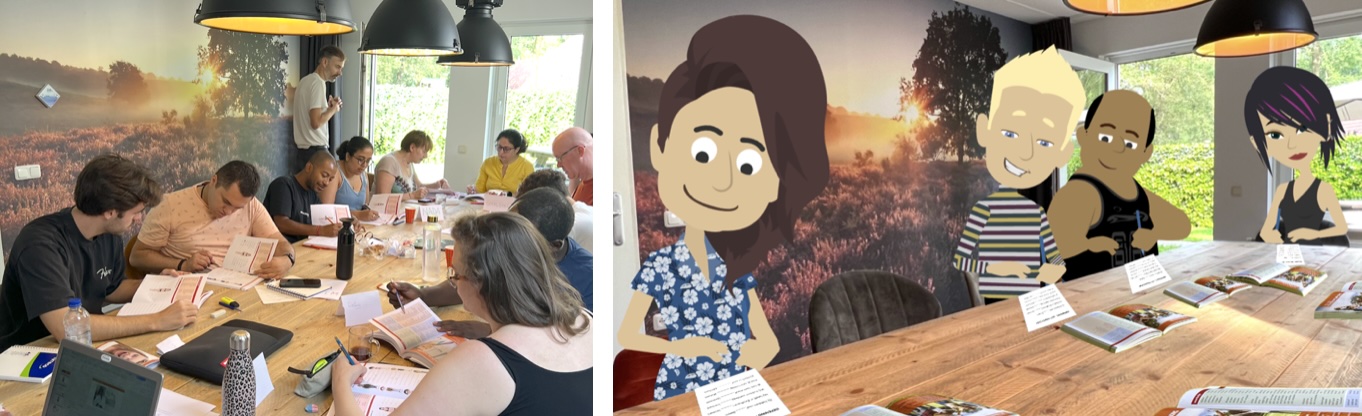
A distinctive element of our program is the integration of narrative media into this immersive environment. As part of their self-study, students watch episodes of the animated Dutch-learning soap opera Heb je zin?. The series was specifically designed as a pedagogical tool and follows fictional international students who travel to a language campus in the Netherlands to learn Dutch.
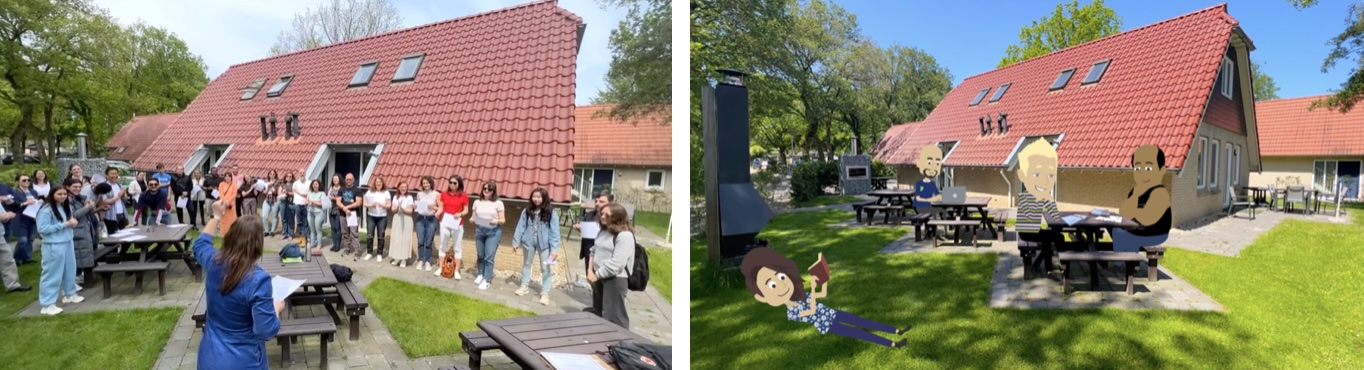
What makes this approach particularly interesting from a pedagogical perspective is that the fictional campus in the series is the same location where the real courses take place.
In the episodes, characters encounter everyday situations such as checking in at their accommodation, renting a bicycle, asking for restaurant recommendations, or planning visits to local museums. These scenarios closely mirror the real experiences of the course participants during their stay on the campus.
This creates an example of situated learning, a concept introduced by Lave and Wenger, which suggests that knowledge is more effectively acquired when learning occurs in the same context in which it will later be applied. When students subsequently encounter these situations in real life, they have already observed similar dialogues in the narrative environment of the series. As a result, the linguistic structures and vocabulary needed for the interaction are already familiar.
In practice, this significantly lowers the barrier to participation in spontaneous conversations. Learners are not encountering communicative situations for the first time; rather, they are reenacting interactions they have previously observed.
The integration of narrative media further enhances engagement. Educational research suggests that storytelling and narrative contexts can improve memory retention and motivation because learners emotionally connect with characters and situations. In the case of Heb je zin?, the fictional narrative and the real learning environment begin to overlap.
Students therefore experience a unique blending of virtual and physical learning spaces. They watch a story about students learning Dutch on a language campus, and then step outside to find themselves in that same environment.
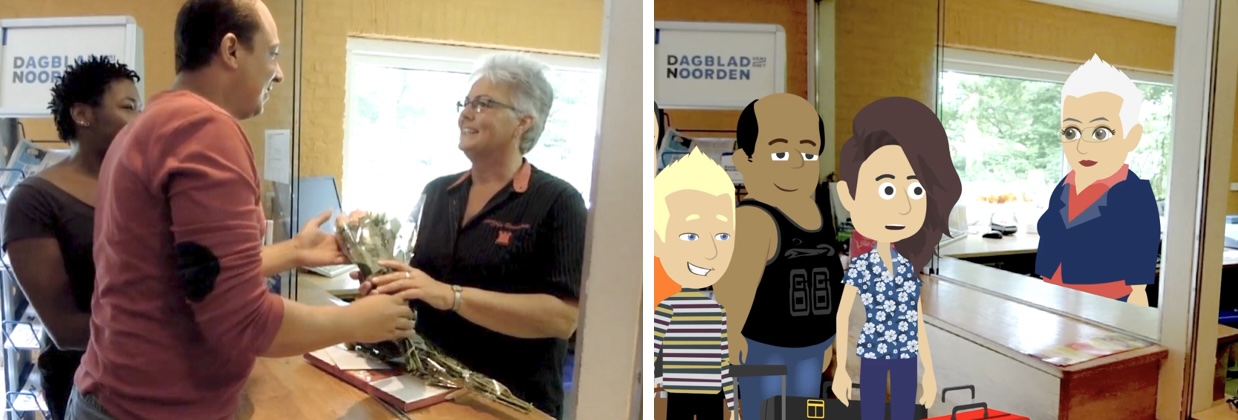
This overlap can even produce humorous moments. One of the animated characters in the series strongly resembles the real receptionist at the park, creating an amusing sense of continuity between the fictional and real worlds.
Another dimension emerges because the Heb je zin? series is freely available on YouTube. Some learners first discover the language course through the series before deciding to participate in the campus program. When they arrive at the park, they often describe the experience as similar to stepping into the setting of a familiar story—comparable to visiting a film set or theme park where previously fictional locations suddenly become real.
To celebrate this connection between fiction and reality, we occasionally organise photo sessions in which students can recreate their favourite scenes from the series together with their favourite “actors.”
By combining blended learning, narrative-based digital materials, and a residential immersive environment, we try to create a language learning ecosystem in which classroom instruction, digital storytelling, and real-life communication mutually reinforce each other. In this model, the most important learning moments may not only occur during the lessons themselves, but also in the many informal interactions that take place throughout the day.
In this sense, language learning on the campus becomes not simply a course, but a continuous 24/7 immersive experience!
Learn more:
– www.dutchsummerschool.nl
– www.dutchwinterschool.nl
Playlist of all ‘Heb je zin?’ episodes ‘recorded’ at the Language Campus:

